
Growing Together Planting Our Futurea Growing Together program

The lessons

One lesson or all six, the same story: a fruit tree planted at a student’s home.

Tell us about your grade level, capacity and constraints, and we’ll customize the content into a sequence of lessons that’ll work for you.

These are outlines. The full lessons carry the facilitation: what you say, the answers you’ll hear back, what to watch for, and the student work to expect. Pilot partners get every lesson in full.

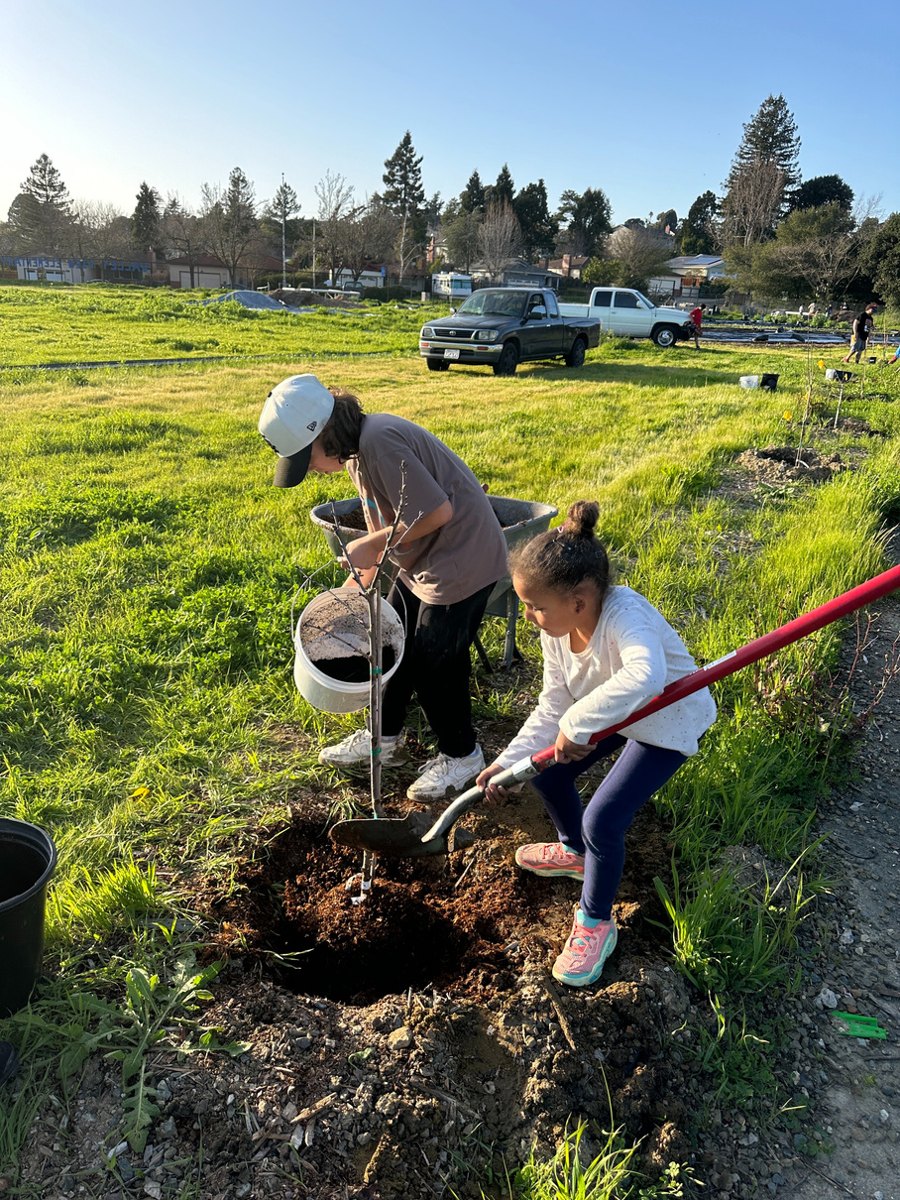
A student in a knit cap and work gloves kneels to set a bare-root fruit tree into a hole in an open field

Build your lesson sequence

  • Five lessons cover the arc of why trees matter all the way through how to plant a fruit tree at home.
  • A sixth, optional, plants a real tree on campus.
Grade band
Not including the optional campus tree planting demo lesson.
The optional sixth
5 lessons 245–270 minutes in total

Students in a classroom hold bare-root fruit trees in nursery pots alongside their worksheets

Your sequence

1

Why trees, and how to bring one home

58 min · Science, ELA · Classroom, with an outdoor upgrade option

58 min · Science, Engineering, ELA · Classroom, with an outdoor upgrade option

The whole journey in one lesson: what trees do for a block, why free trees die, the one rule that keeps a new tree alive, and the sign-up carried home.

  • The arcSee the differenceSort the cards, fastWhy do some free trees die?Plant it right: the one rulePick your family’s treeSend it homeSettle the mystery
  • Students leave withOne thing trees do for a block, the planting mistake that kills new trees, and the family sign-up in their backpack.
  • Goes homeFive bilingual pieces: the pitch starter with the child’s drawing, the variety menu, the home space-checker, the sign-up form, and the family planting guide.

The whole journey in one lesson: the evidence on what trees do, the one rule that keeps a new tree alive, a tree matched to a real home, and the sign-up carried home.

  • The arcSee the differenceBuild the case, fastThe mystery: why do free trees die?Plant it right: the one ruleMatch a tree to your real spaceWrite the pitch, pack the sign-upSettle the mystery
  • Students leave withA tree matched to their real space with reasons, the planting mistake that kills new trees, and the family sign-up in their backpack.
  • Goes homeFive bilingual pieces: the pitch starter with the student’s two-sentence pitch, the variety menu, the home space-checker, the sign-up form, and the family planting guide.
1

Why trees, and how to plant one

60 min · Science, ELA · Classroom, with an outdoor upgrade option

60 min · Science, Engineering, ELA · Classroom, with an outdoor upgrade option

Students see what trees do for a neighborhood, work out why free trees often die, and learn the real planting steps with their whole bodies.

  • The arcSee the differenceSort the cardsWhy do some free trees die?What does a tree need?The planting steps, hands onSolve the dead treeSend home the guide, and close
  • Students leave withOne thing trees do for a block, the planting steps in their bodies, and the family planting guide to teach a grown-up tonight.
  • Goes homeThe bilingual family planting guide. The child has walked it once and can coach the household on planting day.

Students weigh the evidence on what trees do, investigate why free trees die, and learn the planting steps well enough to coach their families.

  • The arcSee the differenceBuild the case, fastThe mystery: why do free trees die?What does a tree need?The steps, hands onSolve the dead treeSend home the guide, and close
  • Students leave withAn evidence-backed case for trees on their block, the planting steps in order, and the family planting guide to teach a grown-up tonight.
  • Goes homeThe bilingual family planting guide. The child has walked it once and can coach the household on planting day.
1

Why trees, why us

50–60 min · Science, ELA · Classroom, with a short outdoor option

Students feel what trees do for a neighborhood, sort the ways trees help, hear the honest story of why free trees often die, and decide together whether their class should bring fruit trees home.

  • The arcFeel the differenceSort the cardsWhy do some free trees die?Decide, and send it homeClose the loop
  • Students leave withOne thing trees do for a block, said in their own words, and a drawing that starts the tree conversation with their family.
  • Goes homeThe bilingual family pitch starter with the child’s drawing.

Students gather evidence about what trees do for a neighborhood, weigh the honest costs, investigate why free trees often die, and write an evidence-backed claim about whether their block should have more trees.

  • The arcFeel the differenceBuild the case, cards to mind-mapThe mystery: why do free trees die?Write the claim, and take it homeClose the loop
  • Students leave withA written claim with evidence about trees on their block, and a family pitch starter that opens the conversation at home.
  • Goes homeThe bilingual family pitch starter with the student’s two-sentence pitch.
2

Meet a tree

50–60 min · Science, ELA · Outdoors, schoolyard or garden

50–60 min · Science, ELA, Math · Outdoors, schoolyard or garden

Every student adopts one real campus tree, learns its parts by looking closely, and starts a journal they will come back to all season.

  • The arcSing the tree firstNotice and wonder, at a treeAdopt and observeWhat do the parts do?Name it and promiseClose the loop
  • Students leave withA tree of their own, its parts learned by looking at the real thing, and a journal page they will add to all season.
  • Goes homeThe completed My Tree Journal page, bilingual. The adopted tree stays at school.

Every student adopts one real campus tree, studies it with a scientific sketch and real measurements, and starts a journal they will keep all season.

  • The arcNotice and wonder, at a treeAdopt and sketch like a scientistMeasure your treeWhat do the parts do?Name it and promiseClose the loop
  • Students leave withAn adopted tree, a scientific sketch, real measurements, and one question worth investigating on the next visit.
  • Goes homeThe completed My Tree Journal page, bilingual. The adopted tree stays at school.
3

How a tree gets planted

50 min · Science · Classroom

50 min · Science, Engineering, Math · Classroom, site check outside

What a tree needs, the real planting steps acted out with the whole body, and the mystery of the tree that died, solved.

  • The arcTwo trees, one streetWhat does a tree need?Walk the steps, hands onThe dead tree mystery, solvedPick the better spotSend home the guide
  • Students leave withThe planting steps in their bodies, and the one mistake that kills new trees.
  • Goes homeThe bilingual family planting guide, walked through once so the child can coach the household.

What a tree needs and the real steps to plant one right, then outside to pick a planting spot and defend it with evidence.

  • The arcTwo trees, one streetWhat does a tree need?The steps, hands onSolve the dead treePick a spot and defend itSend home the guide
  • Students leave withA defended planting spot, the real planting steps, and the job of coaching their family on planting day.
  • Goes homeThe bilingual family planting guide, walked through once so the child can coach the household.
4

Campus planting demo Optional

45–60 min · Science · Outdoors, campus planting site

45–60 min · Science, ELA, Math · Outdoors, campus planting site

A real tree goes in the ground and every student touches a step. Adults and older buddies handle the digging; the kids own the water, the mulch, and the name.

  • The arcCircle up and shovel safetyRecap the stepsDig and measureRoot check and trunk flareBackfill and bermMulch and the deep drinkName it, set the watering schedule
  • Students leave withA real tree the class planted together, and one step each student did with their own hands.
  • Goes homeNothing physical. The recording goes to the family channel, so every family sees the steps before their own planting day.

A real tree goes in the ground and students run the show: they rotate every role, deliver the safety briefing, and call each step before it happens.

  • The arcStudent safety briefingRecap the stepsDig and measureRoot shave and trunk flareBackfill and bermMulch and the deep drinkName it, set the schedule and week-one owner
  • Students leave withA tree the class planted start to finish, every role rotated through student hands, and the steps proven out loud.
  • Goes homeNothing physical. The recording goes to the family channel, so every family sees the steps before their own planting day.
5

Bring it home

45–50 min · Science, ELA · Classroom

45–50 min · Science, Engineering, ELA · Classroom

The lesson where a kid becomes the family ambassador: name the fruit your family loves, match a tree to your real home, and carry the sign-up out the door.

  • The arcThe news, and the questionWhat fruit does your family love?What does a tree need from its spot?Read the menu, check your spaceSend home the sign-upClose
  • Students leave withA chosen fruit, a decorated family invitation, and the sign-up in the backpack.
  • Goes homeThree bilingual pieces: the variety menu, the home space-checker, and the sign-up form, plus the decorated invitation.

Students match a fruit tree to their home’s real conditions, write the pitch that makes the case, and carry the sign-up out the door.

  • The arcThe news, and the questionWhat fruit does your family love?The rules that pick the treeRead the menu, check your spaceWrite the pitch, pack the sign-upClose
  • Students leave withA tree matched to their real space with reasons, and the sign-up ready for the family conversation.
  • Goes homeThree bilingual pieces: the variety menu, the home space-checker, and the sign-up form, carried by a student who can make the case.
2

Bring it home, keep it alive

55 min · Science, ELA · Classroom

55 min · Science, Engineering, ELA · Classroom

Students pick the fruit their family would love, match it to their real home, build the year of care, and carry the sign-up out the door.

  • The arcThe news, and the questionWhat fruit does your family love?Read the menu, check your spaceKeep it alive: the year of careHelps or hurtsSend it home, and close
  • Students leave withA chosen fruit, the care card for the fridge, and the family sign-up in their backpack.
  • Goes homeFour bilingual pieces: the variety menu, the home space-checker, the sign-up form, and the seasonal care card, plus the decorated invitation.

Students match a fruit tree to their home’s real conditions, write the pitch, learn the year of care, and reason through a brand-new care case.

  • The arcThe news, and the questionWhat fruit does your family love?Read the menu, check your spaceKeep it alive: the year of careThe neighbor’s treeWrite the pitch, pack the sign-up
  • Students leave withA tree matched to their real space with reasons, the year of care, and the family sign-up in their backpack.
  • Goes homeFour bilingual pieces: the variety menu, the home space-checker, the sign-up form, and the seasonal care card for the fridge.
6

Keep it alive

50 min, then 10-min monthly check-ins · Science, ELA · Classroom, check-ins outdoors

50 min, then 10-min monthly check-ins · Science, Math, ELA · Classroom, check-ins outdoors

A care game the class plays together, the year of care built from it, and the monthly habit of checking on your tree.

  • The arcThe question that’s leftPlay the care gameBuild the year of careHelps or hurtsClose the board, and send homethen monthly check-ins
  • Students leave withThe care habits in their hands, the care card for the fridge, and a tree check-in habit that starts this month.
  • Goes homeThe bilingual seasonal care card, into the take-home packet next to the planting guide.

The care game in small groups, the year of care built from it, a brand-new case to reason through, and a monitoring log students own.

  • The arcThe question that’s leftPlay the care gameBuild the year of careThe neighbor’s treeClose the board, send home, log entry onethen monthly check-ins
  • Students leave withThe year of care, the 30-second health check, and a monitoring log they own.
  • Goes homeThe bilingual seasonal care card, into the take-home packet next to the planting guide.
Rows of young potted fruit trees staged in a nursery, tagged and ready to go out

What comes with it

Everything you need, minus the trees.

Our program materials come with classroom-ready printouts and lesson materials. The pieces that go home to families are bilingual, English and Spanish.

  • The fact-card deck, the two street photos, and the family pitch starter
  • The parts-of-a-tree song card
  • My Tree Journal
  • Need cards and distractor cards
  • The planting-steps card sequence
  • The site-checker worksheet
  • The family planting guide
  • The variety menu and home space-checker
  • Sign-up forms, on paper and by QR
  • The care game and the seasonal care card
  • The monitoring photo guide
  • Role cards for the campus planting

Made for real classrooms

Written where the constraints actually are.

Families who rent

A tree in a pot on a balcony, at a relative’s house, or in a community garden is a real tree, and every lesson that sends a tree home teaches it as an equal option, not a fallback. Most of our families rent.

Campuses without planting room

Only the campus demo needs ground. Everything else runs with a container demo, a street tree, or a park tree on the walking route.

Big classes

Every lesson carries a large-class variation: cards to pairs, trees to pairs, station rotations. They come from classrooms we’ve actually taught in.

A class walks a mulched planting bed with their teacher, past young trees along the fence

The full lessons come with the pilot.

Five schools or organizations, anywhere in the country, get the full lessons, the playbook to run it, and mentorship through your first season. We’re picking partners for 2026–27.